Cybersecurity threats are accelerating at an alarming rate. In 2025, over 90 percent of cyberattacks were detected only after significant damage had occurred. Traditional monitoring methods, which rely on periodic scans or manual log reviews, are no longer sufficient.
This is why real-time threat monitoring has become essential. It continuously observes systems, networks, and users, analyzes activity as it happens, and enables immediate response to potential threats.
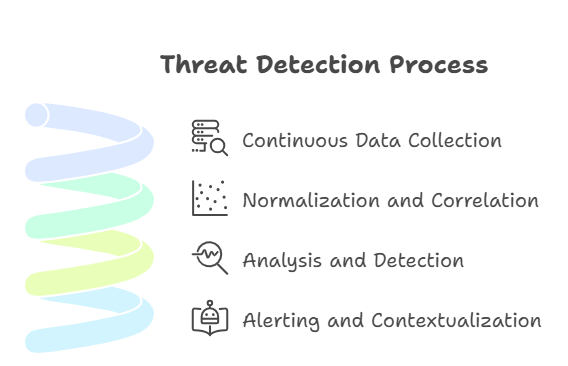
Real-time threat monitoring transforms raw data into actionable intelligence through a structured threat detection process:
Continuous Data Collection
Logs, system events, network traffic, and user activity are gathered from endpoints, cloud workloads, servers, and applications. Every action generates signals that can indicate potential threats.
Normalization and Correlation
Data from multiple sources is structured and analyzed together to identify patterns, anomalies, or potential indicators of compromise.
Analysis and Detection
Detection is achieved through a combination of approaches:
Rule-based detection identifies known threats using predefined signatures
Threat intelligence feeds flag activity associated with known attackers
Machine learning uncovers previously unknown threats by recognizing unusual patterns
Alerting and Contextualization
Once a threat is identified, alerts are generated along with context such as severity, affected systems, and potential impact. This allows security teams to respond efficiently.
SOC Workflow Monitoring
The Security Operations Center is the nerve center of real-time threat monitoring. SOC workflow monitoring ensures that detection is connected directly to investigation and mitigation.
Key workflows include:
Incident Triage – Alerts are validated, categorized, and prioritized
Investigation – Analysts trace the threat, understand its scope, and assess impact
Response and Containment – Systems can be isolated, malicious activity blocked, and workflows executed automatically or manually
Continuous Feedback – Lessons from incidents improve detection rules and machine learning models for better future monitoring
Integrating real-time monitoring with SOC workflows ensures threats are addressed immediately and effectively.
Real-time monitoring relies on a coordinated set of tools:
SIEM collects and correlates logs across systems
XDR provides unified visibility across endpoints, networks, and cloud
NDR monitors network traffic to detect anomalies and lateral movement
EDR provides deep visibility into endpoint activity
SOAR automates response workflows to reduce time from detection to action
Together, these technologies create a continuous, connected, and intelligent monitoring ecosystem.
Why Understanding How Threat Monitoring Works Matters
Knowing how real-time threat monitoring works helps organizations:
Detect threats faster as they emerge
Contextualize alerts for accurate prioritization
Automate responses to reduce risk and damage
Adapt to evolving attack patterns and dynamic environments
Without this understanding, monitoring can become reactive instead of proactive. Real-time monitoring ensures security teams stay ahead of threats.
Real-Time Threat Monitoring with NewEvol
Technology alone is not enough to stay ahead of threats. NewEvol approaches real-time threat monitoring as a continuously evolving capability rather than a static solution.
By integrating SIEM, XDR, NDR, and advanced analytics with contextual threat intelligence, NewEvol ensures detection is immediate, meaningful, and actionable. Events are not treated in isolation—they are correlated, enriched, and prioritized based on real-world risk.
NewEvol adapts its approach across regions such as the United States, Middle East and Africa, and India, addressing specific regulatory requirements, threat landscapes, and operational complexities.
In the United States, the focus is on regulatory alignment, breach readiness, and advanced threat detection.
In the Middle East and Africa, organizations benefit from proactive monitoring as they rapidly scale digital infrastructure.
In India, the emphasis is on compliance, cloud security, and managing large, dynamic user environments.
This regional adaptability ensures that organizations are not only monitoring threats but staying ahead of them.
End Note
Real-time threat monitoring works by continuously collecting data, analyzing events, and connecting detection to immediate response. By integrating intelligent detection with SOC workflows and automation, organizations can reduce dwell time and prevent damage.
Understanding this process is essential for maintaining a proactive cybersecurity posture. Organizations that master real-time threat monitoring gain the ability to protect critical assets in real time.
FAQs
1. What is real-time threat monitoring?
Real-time threat monitoring continuously observes systems, networks, and users to detect threats immediately, enabling faster response and reduced damage.
2. How does real-time threat monitoring work?
It collects data from multiple sources, correlates events, applies behavioral and intelligence analysis, and generates alerts for SOC teams to investigate and respond.
3. What is the threat detection process in real-time monitoring?
The process involves continuous data collection, normalization, correlation, analysis through rules, behavioral patterns, or AI, and generating context-rich alerts for action.
4. How does SOC workflow monitoring support real-time threat detection?
SOC workflows connect detection to response, including alert triage, investigation, containment, and continuous feedback to improve monitoring effectiveness.
5. How does NewEvol enhance real-time threat monitoring?
NewEvol combines SIEM, XDR, NDR, and advanced analytics with threat intelligence, providing meaningful, actionable detection tailored to regional requirements in the US, MEA, and India.
Krunal Medapara
Krunal Mendapara is the Chief Technology Officer, responsible for creating product roadmaps from conception to launch, driving the product vision, defining go-to-market strategy, and leading design discussions.
Related Product
SIEM
SIEM Solutions Empowers Threat Detection & ongoing Monitoring in Real-Time