
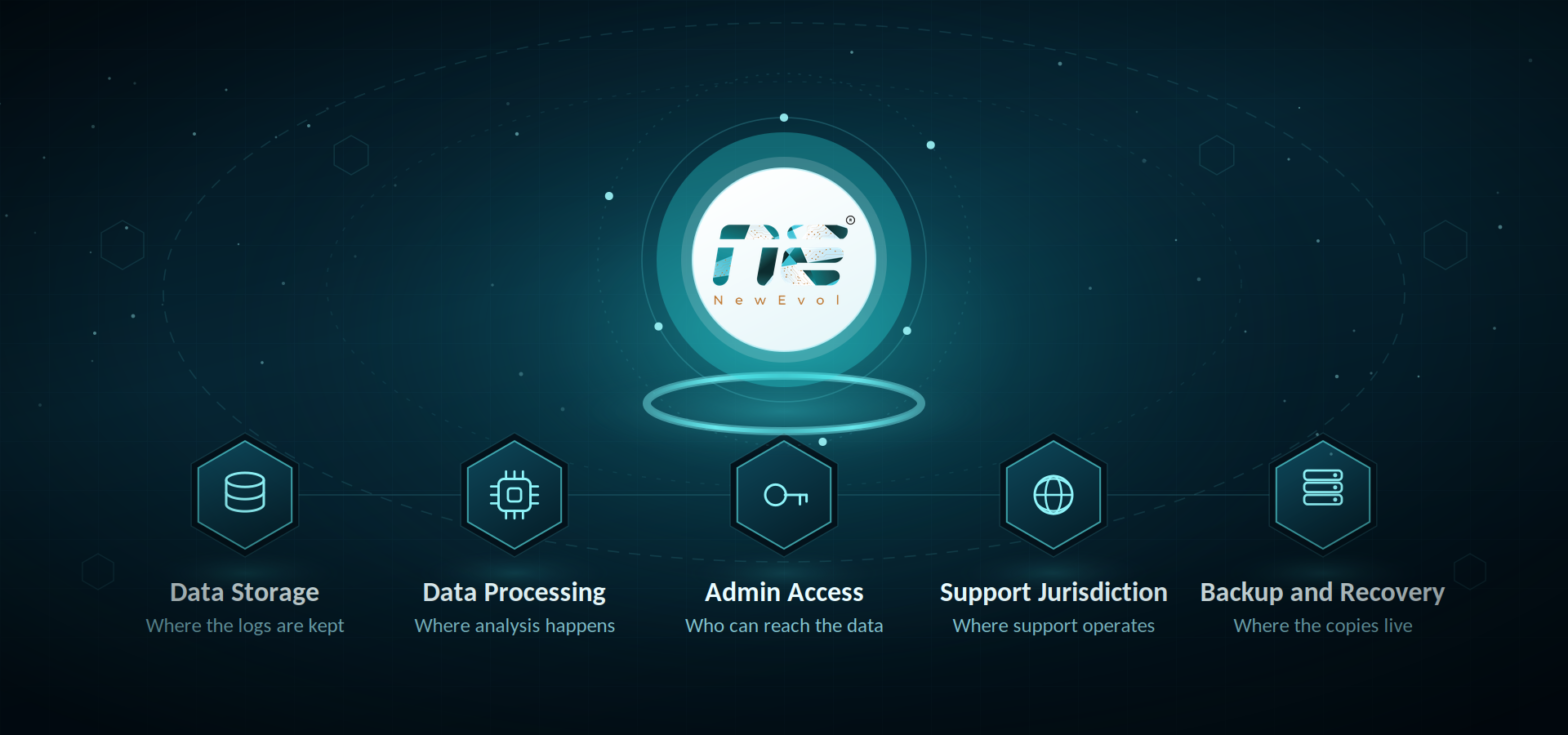
Most SIEM discussions in the UAE public sector open with one question: is the platform hosted inside the country? It is a fair starting point, but it rarely settles the issue.
A SIEM does not simply store logs. It moves, copies, indexes, analyses, and backs them up, and it exposes them to the people who administer and support the system. Each of those activities has a location attached to it, and those locations are not always the ones on the deployment diagram.
This guide turns out that into four questions a UAE government security or procurement team can put directly in front of a SIEM vendor, plus a checklist for an evaluation or tender.
What Data Residency Means for UAE Government SIEM Deployments
Requirements for a UAE government SIEM usually come from more than one place. Treat them as a stack:
- Federal policies and requirements. National-level policies, standards, and guidance applying across government entities.
- Emirate-level directions and frameworks. Individual emirates issue their own cybersecurity and data frameworks, and these can differ.
- Sector-specific regulatory requirements. Entities in areas such as financial services, health, energy, or telecom may answer a sector regulator with its own rules on data location and access.
- Procurement, contractual, and organizational requirements. Internal security policies, tender conditions, and contract clauses.
The fourth layer is the one teams underestimate. Procurement requirements often go beyond the legal minimum. A contract may require that all security data remain physically inside the UAE and that privileged access be approved in advance, even where no statute demands it in those terms. The contract is still binding.
So “is this legal?” and “does this meet our requirements?” are different questions, and nobody can answer them generically. Confirm what applies to your specific entity, emirate, sector, and contract with your legal, compliance, procurement, and cybersecurity teams.
The Four Questions Every Government SIEM Assessment Should Answer
Vendor claims become verifiable when you break them into four operational questions. Ask all four. A strong answer to one does not cover the others.
1. Where Is the Data Stored?
Ask the vendor to document the location of every copy of your security data, not just the primary one:
- Primary SIEM data location and hosting arrangement
- Log storage and hot index tiers
- Security event data, alerts, and case records
- Archived and cold-tier data
- Replicated data across nodes, sites, or regions
- Temporary storage such as queues, buffers, caches, and staging areas
- Disaster recovery infrastructure
- Backup storage, including vendor-managed or third-party backup services
Location matters physically and logically. Physical location tells you which country the hardware sits in. Logical location tells you who operates it and whose staff can mount or restore it. A backup held on UAE soil but managed from a foreign console is a different position from one operated locally, so security log data residency is established only when both answers are documented.
2. Where Is the Data Processed?
Storage location does not establish where data is handled. Processing can happen elsewhere, sometimes briefly and often without appearing on the architecture diagram. Ask where each of these takes place:
- Event ingestion, parsing, and normalisation
- Analytics and reporting
- Correlation and rule evaluation
- AI or machine learning processing, including model hosting
- Threat detection and enrichment lookups
- Search and investigation queries run by analysts
- Temporary processing such as transient compute or managed services
- Any cloud services or subprocessors involved in processing
Enrichment deserves attention: threat intelligence lookups, reputation checks, and sandbox submissions can send indicators, hashes, or file samples outside the deployment even when the SIEM is fully on premises. Request a written list of every processing location and subprocessor, and ask what leaves the environment by default.
3. Who Has Administrative Access?
Administrative access can create residency and governance concerns even when the SIEM is hosted entirely inside the UAE. Anyone with platform administrator rights can read logs, export data, and change retention regardless of where the servers sit. Storage location controls the data. Access control decides who can actually see it.
Put these questions to the vendor:
- Which vendor administrators hold standing access?
- Do support engineers have access, and under what conditions?
- Can vendor security operations teams reach your environment?
- Is remote access possible, and through which channel?
- How many privileged accounts exist, and who owns them?
- Who approves access, and is that approval recorded?
- Is just-in-time access available so rights expire automatically?
- Are administrative sessions logged or recorded?
- Is access monitored, and can your team retrieve those records?
- Is customer approval required before any privileged access?
- Can third parties or subcontractors obtain access?
The answer you want is specific: named roles, an approval workflow for your team controls, time-limited elevation, and session records you can produce during an audit. “Access is restricted” is a statement, not evidence.
4. Under Which Jurisdiction Does Vendor Support Operate?
Support is often the weakest link in an otherwise well-documented residency position, because it is negotiated late and described loosely. Determine:
- Where support personnel are physically located
- Which legal entity provides support, and where it is registered
- Where support tickets, screenshots, and diagnostic bundles are stored
- Whether remote troubleshooting can expose live security logs
- Whether offshore personnel participate in follow-the-sun coverage
- Whether third-party support providers or resellers are involved
- Which jurisdiction governs the support relationship
- What contractual controls apply to support access, including approval, logging, and data handling
These terms are commonly overlooked during evaluation, then become important during audits, security reviews, procurement assessments, and incident investigations. During a serious incident, the pressure to grant a support engineer fast access is highest and the appetite for paperwork is lowest. Decide the rules before that day.
Why Backup Location Matters
A primary SIEM deployment can sit comfortably inside the required jurisdiction while backups, replicas, disaster recovery systems, or archived logs sit somewhere else. Backups often follow a different design path from production, chosen for cost or convenience, and they usually hold the same sensitive content.
Ask where each backup and archive copy resides, who operates on the backup platform, how long copies are kept in each location, and whether disaster recovery failover would move data across a border. Ask for a storage map and a retention schedule, not an assurance.
Why Vendor Support Access Requires Extra Scrutiny
A system can be hosted locally while vendor personnel outside the UAE retain the ability to reach administrative interfaces, logs, diagnostic information, or security data. This is not theoretical: diagnostic bundles routinely contain log samples, configuration files, and user details; a screen-sharing session shows live data, and a ticket attachment can carry event records into a support platform hosted abroad.
Treat a statement as narrow as “the SIEM is hosted in the UAE” as an opening answer. Ask for evidence covering the full lifecycle: storage, processing, access, support, backup, and deletion.
UAE Government SIEM Vendor Assessment Checklist
|
# |
Question to ask the vendor |
Evidence to request |
|
1 |
Where is primary SIEM data stored? |
Data centre name, country, operator |
|
2 |
Where are backups stored? |
Backup storage map and retention schedule |
|
3 |
Where are disaster recovery systems located? |
DR site location and failover behaviour |
|
4 |
Where is security data processed? |
Processing locations listed by function |
|
5 |
Are any subprocessors involved? |
Named subprocessor list with locations |
|
6 |
Where are support personnel located? |
Support model and staffing locations |
|
7 |
Can vendor personnel remotely access the environment? |
Access method and network path |
|
8 |
Is customer approval required before privileged access? |
Documented approval workflow |
|
9 |
Are administrative sessions logged? |
Sample session log or recording |
|
10 |
Where are support tickets stored? |
Ticketing platform hosting location |
|
11 |
Can diagnostic data leave the UAE? |
Diagnostic data handling policy |
|
12 |
Which legal entity provides support? |
Entity name and registration |
|
13 |
Which jurisdiction governs vendor support? |
Governing law clause |
|
14 |
Are data location commitments in the contract? |
Contract clause reference |
|
15 |
Will storage, processing, access, and backup locations be confirmed in writing? |
Signed residency statement |
|
16 |
What happens to data when the contract ends? |
Exit and data return procedure |
|
17 |
How are retained copies and backups securely deleted? |
Deletion process and certificate |
Questions to Ask Before Signing a SIEM Contract
Move the important answers out of the proposal deck and into the agreement. Before signature, confirm that the contract names permitted data locations, requires notice before any location change, sets approval and logging rules for privileged access, identifies subprocessors and how new ones are added, defines support jurisdiction, and specifies data return and deletion at exit. A commitment that exists only on a slide is hard to enforce during an audit.
On-Prem SIEM vs Cloud SIEM: What Government Teams Should Actually Verify
Neither model is automatically suitable for every entity. The useful comparison is about control and evidence.
|
Consideration |
On-premises SIEM |
Cloud SIEM |
|
Data location |
Determined by your own facility |
Determined by provider regions and tenancy |
|
Infrastructure control |
Held by your team |
Shared with the provider |
|
Administrative access |
Internal, plus vendor support access |
Provider platform teams plus your administrators |
|
Processing location |
Local, subject to enrichment and integration flows |
May span regions and managed services |
|
Backups and DR |
Your design, your locations |
Provider design, verify region and replication |
|
Operational burden |
Higher internal effort for infrastructure and upgrades |
Lower infrastructure effort, higher contractual scrutiny |
|
Evidence needed |
Local access governance and support terms |
Region commitments, subprocessors, support terms |
An on-premises SIEM UAE deployment gives direct control over infrastructure, which is why it is often preferred where residency requirements are strict, though it does not remove the need to govern support access, subprocesses, or backup location. A cloud of SIEM can be configured to meet demanding requirements, but the evidence is contractual and architectural rather than physical. Either way, the four questions stay the same.
Common Data Residency Gaps in SIEM Procurement
- Confirming the primary site and never checking backups or archives
- Accepting “hosted in the UAE” without asking who administers the platform
- Overlooking threat intelligence and enrichment traffic leaving the environment
- Treating support as an operational detail rather than an access pathway
- Allowing standing vendor administrator accounts with no expiry
- Leaving residency commitments in the proposal instead of the contract
- Failing to define what happens to data and backups at contract exit
How Operational Automation Fits into a Government SOC
Automation shapes how much data moves, where analysis happens, and how often someone outside your organisation needs to open a case to help. When enrichment, correlation, and case handling run inside the local deployment, fewer investigations need vendor involvement and less diagnostic information travels outward.
That makes SOC alert triage automation a residency question as well as a productivity one, because triage that executes locally keeps the analysis, the context, and the decision trail inside the environment you control. Platforms built for local deployment, such as NewEvol, illustrate the on-premises approach, where detection, correlation, and response workflows run within the entity’s own infrastructure. Whichever platform you assess, ask where automated processing takes place.
Conclusion
For UAE government entities, SIEM data residency should be assessed across the entire data and access lifecycle, not by asking where the server is hosted. Four questions do most of the work: where data is stored, where it is processed, who can administer it, and which jurisdiction governs support. Give weight to backup location and support access; the two areas most often missing vendor answers.
Use the checklist as a working document: ask for written confirmation, record the responses, and move the commitments into the contract. Then validate the outcome with your legal, compliance, procurement, and cybersecurity teams, who are the only people positioned to confirm what your entity, emirate, sector, and agreement require.
FAQ
1. Does hosting a SIEM in the UAE satisfy data residency requirements?
Not on its own. Processing locations, backups and archives, administrative access, and support of jurisdiction in all forms of the position. Confirm your specific requirements with your legal and compliance teams.
2. Is an on-premises SIEM mandatory for UAE government entities?
There is no single answer for every entity. Requirements vary by federal policy, emirate-level direction, sector regulator, and your own procurement of documents and contracts. Validate the combination that applies to you.
3. Why do backups matter so much in a residency assessment?
Backups, replicas, and archives hold the same sensitive data as production but are often designed and hosted differently. A compliant primary deployment with an offshore backup copy still leaves a gap.
4. Can vendor support access create a compliance issue with a local deployment?
Yes. Remote administrative access, diagnostic bundles, screen sharing, and ticket attachments can expose security data to personnel outside the country. Ask where support staff sit, which entity employs them, and what approval and logging controls apply.
5. What should we ask about administrative access?
Who holds privileged accounts, whether access is standing or time-limited, whether your approval is required before each session, whether sessions are logged, and whether subcontractors can ever be granted access.
6. What evidence should a SIEM vendor provide during procurement?
A written statement of storage, processing, access, support, and backup locations, a named subprocessor list, an access governance description, and contract clauses covering data location, change notification, and deletion at exit.