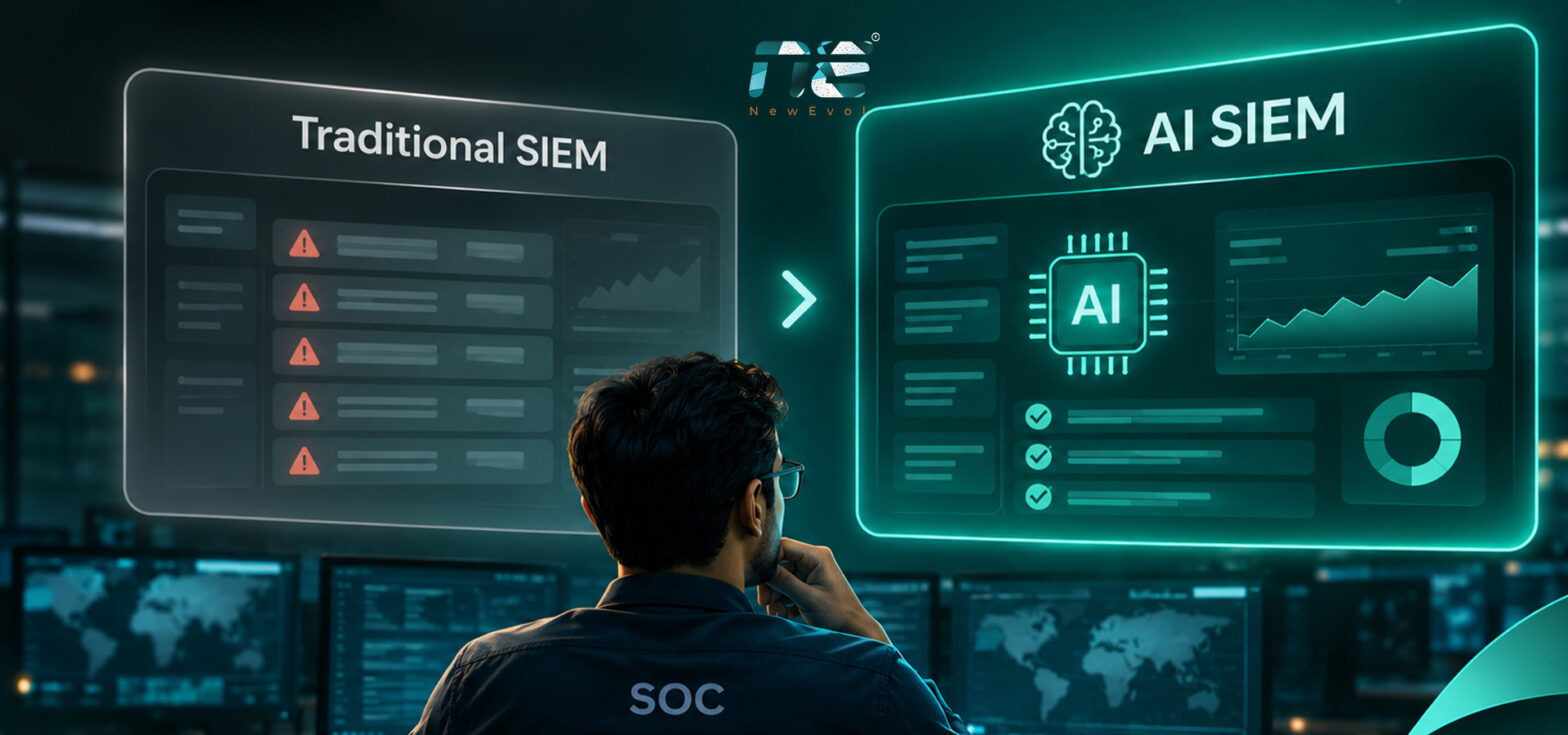
hem, the useful question is not whether a platform has AI, but what changes at thFor more than a decade, security information and event management (SIEM) has been the center of most security operations centers. A traditional SIEM collects logs from firewalls, endpoints, servers, and cloud services, stores them in one place, and runs correlation rules that raise alerts when known patterns appear. Analysts then work through those alerts, one queue at a time.
That model still works, but it strains under modern data volumes. Cloud workloads, remote users, and SaaS applications produce far more telemetry than rule writers can keep up with, and analysts spend much of each shift on alerts that turn out to be harmless. AI-powered security operations aim to ease that load by learning normal behavior, ranking risk, and assembling context automatically.
The difficulty is that almost every vendor now uses the word “AI.” For SOC analysts and the managers who lead te console during an ordinary night shift. This article looks at those practical differences, what AI does not replace, and how to test the claims before you commit.
Traditional SIEM vs AI SIEM: The Core Differences
An AI-powered SIEM usually keeps the same data foundation as a traditional one and adds a layer that learns, ranks, and connects. The table below compares the two across five areas.
|
Area |
Traditional SIEM |
AI-powered SIEM |
|---|---|---|
|
Architecture |
Central log store, correlation engine, and rule library |
Same foundation, plus models that learn baselines for users, hosts, and applications |
|
Threat detection |
Rule and signature matches for known patterns |
Rules plus behavioral anomaly detection for activity no rule describes |
|
Data analysis |
Analysts write queries and pivot between events manually |
Related events are grouped and enriched, with suggested next queries |
|
Automation |
Scripted actions, often in a separate SOAR tool |
Context-aware playbooks that recommend or trigger actions with approval gates |
|
Analyst workflow |
A long, flat alert queue worked in time order |
A shorter, risk-ranked queue of grouped incidents with context attached |
Log collection, parsing, retention, and correlation rules do not disappear. Rules remain the most reliable way to catch known techniques and meet compliance requirements. What AI adds is a second layer that looks for the unknown and does the first round of sorting before an analyst opens the case.
What Actually Changes for SOC Analysts
The biggest shift is in how analysts spend their time: less on sorting and searching, more on judgment. Here is how that plays out across the SOC analyst workflow.
Detection: Seeing Beyond Predefined Rules
A correlation rule can only catch what someone thought to write down. AI-driven threat detection adds behavioral baselines: how a user normally signs in, which servers a service account talks to, and how much data a workstation usually sends out.
Consider a finance user whose account signs in at the usual hour from the usual city, so no rule fires. The account then opens a file share it has never touched and uploads several gigabytes to a personal cloud storage site. Each step looks legitimate alone, but a behavior model flags the combination as unusual. The analyst’s role shifts from writing ever more rules toward reviewing anomalies and deciding which ones matter. Anomaly models also create noise, especially while they learn, so tuning them becomes part of the job.
Alert Triage: A Shorter, Ranked Queue
In a traditional SOC, triage means opening each alert, checking the asset, looking up the user, and searching threat intelligence before closing it as benign. Much of that is repetitive.
AI-assisted triage scores alerts using asset criticality, user risk, threat intelligence matches, and how similar alerts were resolved before. Duplicates are grouped. Twenty failed-login alerts from one host become a single incident, ranked high because the target is a domain controller. L1 analysts close fewer obvious false positives and spend more time on cases that need thought. If scoring is wrong, though, a real threat can sit low in the queue, so teams should review low-ranked and suppressed items regularly.
Incident Investigation: Context Arrives With the Alert
Investigation in a traditional SIEM is mostly manual pivoting: search the IP, then the user, then the endpoint logs, then build a timeline in a ticket. Automated security investigation shortens this. The platform links related alerts into one incident, pulls in identity, endpoint, and network events, and drafts a timeline with a plain-language summary.
A phishing email, a macro execution, and an outbound connection to a rare domain might arrive as three alerts from three tools. AI correlation connects them by user and host and presents one story with evidence attached. The analyst still verifies each link but starts from a hypothesis instead of a blank search bar.
Response and Automation: Faster Actions, Human Approval
SOC automation is not new; scripted playbooks have existed for years. The difference is that AI-driven workflows can select and adapt playbooks based on incident context and explain why they recommend an action.
Low-risk steps such as enriching an indicator, opening a ticket, or ending a suspicious session can run automatically. High-impact steps such as isolating a production server, disabling an executive’s account, or blocking a partner’s IP range should wait for analyst approval. A good setup makes that point explicit: the platform proposes, the analyst decides, and the action is logged.
Reporting: Less Writing, More Reviewing
Documentation is a large hidden cost in any SOC. AI can draft incident summaries, shift handover notes, and management reports from case data, so analysts edit rather than write from scratch. Those drafts still need checking. A generated summary can misstate a timeline or overstate impact, and these reports often feed audits and regulatory filings.
What AI-Powered SIEM Does Not Replace
AI changes how analysts spend their time, but it does not remove the need for them. Several things stay firmly in human hands:
- Skilled analysts. Models flag deviations; people understand whether a deviation is a threat in the context of the business.
- Judgment on high-impact decisions. Containing a system that runs payroll or cutting a partner connection has business consequences a model cannot weigh.
- Security expertise. Threat hunting, adversary knowledge, and detection engineering still depend on experienced practitioners.
- Governance and validation. Someone must own model tuning, review automated actions, and confirm AI findings before they shape a response.
- Accountability. When an incident reaches leadership, auditors, or regulators, a named person and team remain responsible for what happened.
The safest way to think about AI in the SOC is as an assistant that does the first pass, not as the decision maker.
From AI-Driven SIEM to Agentic SOC
An Agentic SOC is one where AI agents carry out defined parts of the workflow with a degree of autonomy, inside limits the security team sets. It rests on four capabilities:
- Intelligent analysis: agents gather and correlate evidence across data sources without waiting for an analyst to search.
- Contextual decision support: findings arrive with reasoning, risk context, and a recommended next step.
- Coordinated workflows: agents hand tasks to each other and to connected tools, such as identity, endpoint, and ticketing systems.
- Controlled automation: every agent works within permissions and approval rules the SOC defines.
In practice, an agent might receive a suspicious login incident, pull identity logs, check the device’s endpoint status, compare the location with the user’s recent activity, and hand the analyst a recommendation with evidence attached. The analyst approves it, rejects it, or asks for more detail.
This is the thinking behind NewEvol’s positioning of an AI SIEM that converts your SOC into an Agentic SOC. The SIEM stops being only a place where alerts are stored and becomes a layer that coordinates analysis and action, while analysts direct the work.
Practical Questions to Ask Before Adopting an AI-Powered SIEM
Demos are built to impress. These questions test whether a platform will help your analysts on your own data:
- How does the platform improve detection accuracy? Ask for false positive and false negative results from a proof of concept on your logs, not vendor benchmarks.
- Can it explain why an alert is considered suspicious? Analysts should see the specific behaviors, baselines, and evidence behind every score.
- How does it prioritize and correlate alerts? Find out which factors drive risk scores and whether your team can adjust them.
- Can analysts validate AI-generated investigation findings? Every summary should link back to the raw events it came from.
- What level of automation and human approval is supported? Look for approval gates you can set per action type, with full audit logs.
- How does it integrate with existing security tools? Check connectors for your EDR, identity, cloud, ticketing, and SOAR platforms.
- Can it demonstrate measurable improvements in SOC efficiency? Agree on baseline metrics such as mean time to triage and mean time to respond before the trial, then compare.
Conclusion: A Different Day at the Console
Moving from traditional SIEM to AI-driven security operations changes the SOC analyst workflow more than the purpose of the SOC. Analysts gain better visibility into behavior no rule anticipated, a ranked queue instead of a flat one, investigations that start with context, and less time spent on repetitive enrichment and documentation. What stays the same is the need for skilled people to validate findings, make high-impact calls, and own the outcome.
The best way to judge any platform is by those daily changes, measured on your own data. NewEvol builds its approach around that balance, using AI to move security teams toward an Agentic SOC while keeping analysts in control of the decisions that matter most.
Frequently Asked Questions
1. What is the difference between traditional SIEM and AI-powered SIEM?
Traditional SIEM relies mainly on predefined correlation rules to detect known threats. AI-powered SIEM keeps those rules and adds behavioral analytics, risk-based prioritization, and automated investigation support.
2. Will AI-powered SIEM replace SOC analysts?
No. It reduces repetitive work such as initial triage and enrichment, but analysts still validate findings, investigate complex incidents, and make high-impact response decisions.
3. Does AI eliminate false positives?
No. It can reduce noise by grouping and ranking alerts, but anomaly models generate their own false positives and need ongoing tuning.
4. What is an Agentic SOC?
An Agentic SOC uses AI agents to carry out defined tasks, such as gathering evidence, correlating alerts, and recommending actions, within permissions and approval rules set by the security team.
5. Do we still need correlation rules with AI-driven threat detection?
Yes. Rules remain the most dependable way to detect known techniques and meet compliance requirements. AI works alongside them to catch unusual activity that rules do not cover.
6. How should we measure the value of an AI-powered SIEM?
Set baselines before deployment for metrics such as mean time to triage, mean time to respond, alerts handled per analyst, and false positive rate. Then compare the same metrics after a defined period.