Security Operations Centers are under more pressure than ever. A typical SOC team receives thousands of alerts every day from firewalls, endpoints, cloud services, identity systems, and email gateways. Many of these alerts are low risk or duplicates, yet each one still needs someone to look at it.
This creates a familiar set of problems. Analysts spend hours on repetitive checks, such as looking up an IP address or confirming which user owns a device. Real threats can sit in the queue while the team works through noise. And as organisations add more cloud workloads, remote users, and security tools, the environment becomes harder to monitor as a whole.
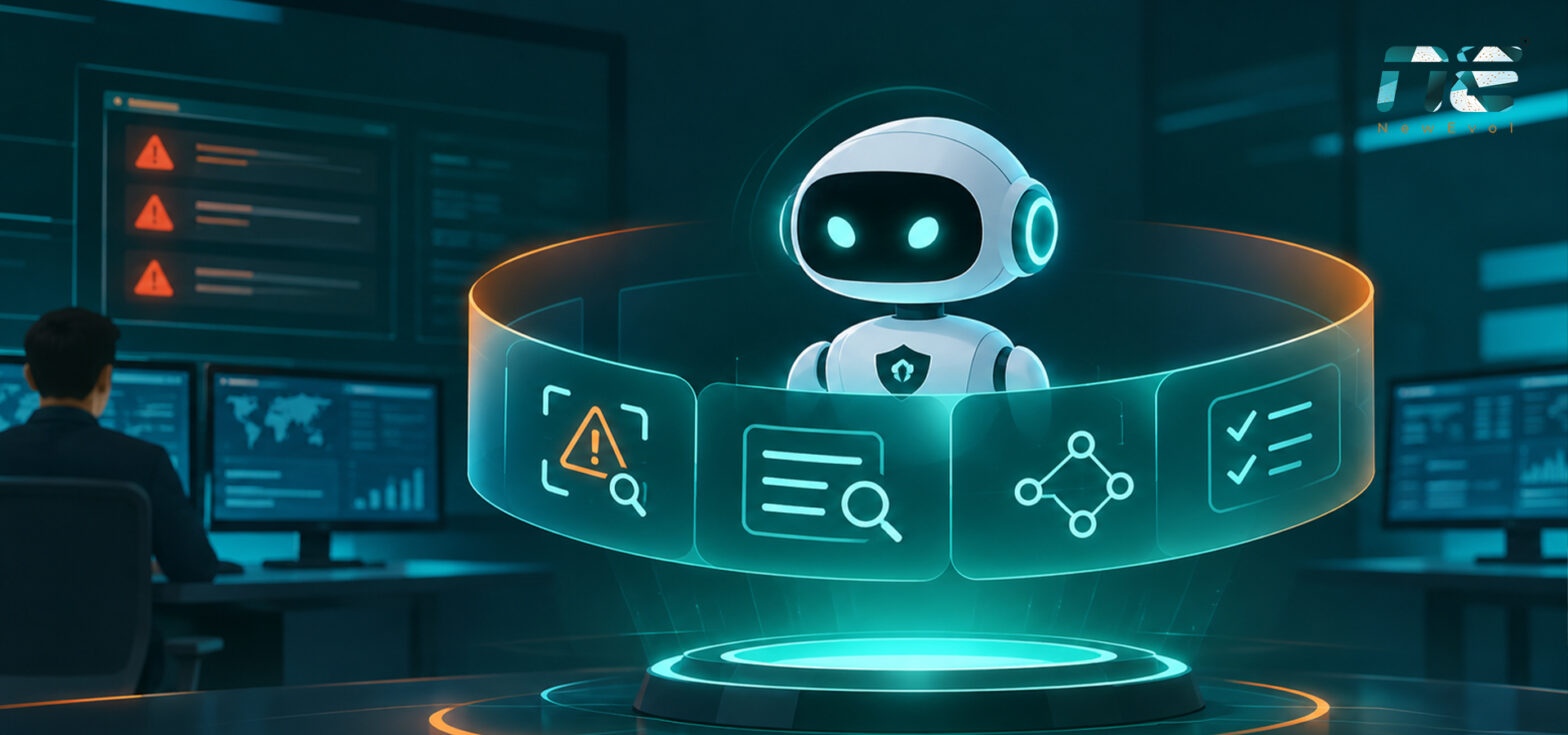
An Agentic SOC is one response to this pressure. Instead of relying only on fixed rules and manual effort, it uses AI agents that can carry out defined investigation tasks on their own, within clear limits. The idea is gaining attention because it targets the most time-consuming part of security work: the early stages of triage and investigation that happen before a human makes a decision.
What Does “Agentic” Mean for a Security Operations Center?
In simple terms, an agentic security operation is one where AI agents work towards a security goal rather than only following a fixed script. An AI agent is given an objective, such as “decide whether this login alert is suspicious”, and it works out the steps needed to reach that objective.
To do this, an agent typically:
- Analyses information from logs, alerts, and connected security tools.
- Makes context-based decisions, such as which data source to query next or whether an alert looks like a known false positive.
- Carries out specific tasks, such as gathering evidence, running a threat intelligence lookup, or drafting a case note.
- Works within defined permissions, meaning it can only access the data and take the actions it has been allowed to.
This is what separates AI agents in cybersecurity from basic SOC automation. Traditional automation runs the same steps every time a trigger fires. An agent adapts its steps to what it finds, much like a junior analyst who knows where to look next. The difference is that the agent does this at machine speed and never gets tired of repetitive work.
How AI Agents Handle Security Alert Triage
Security alert triage is the process of deciding which alerts matter, which can wait, and which can be closed. It is also where most analyst time goes. Here is how AI agents can take on this work.
Analysing Incoming Alerts
When an alert arrives, the agent reads it and identifies what kind of event it describes, which systems are involved, and which user or device is affected. This gives every alert a consistent first review, even during peak hours.
Enriching Alerts With Context
A raw alert rarely tells the full story. The agent adds context by checking threat intelligence sources for known malicious IPs, domains, or file hashes. It also pulls asset details, such as whether the affected server holds sensitive data or belongs to a critical business function.
Finding Relationships Between Alerts
Attacks rarely produce a single alert. A phishing email, a suspicious login, and an unusual file download may all be part of the same incident. AI agents can spot these links by matching shared users, hosts, IP addresses, and time windows.
Correlating Events Across Security Tools
Most organisations use separate tools for endpoints, network traffic, identity, and cloud activity. An agent can query each of these sources and bring the relevant events together, so the analyst does not have to switch between multiple consoles.
Prioritising by Risk and Business Impact
Once an alert is enriched and correlated, the agent can rank it. A medium-severity alert on a payroll server may deserve more attention than a high-severity alert on an isolated test machine. Prioritisation that considers business impact helps analysts focus on what matters first.
Reducing Repetitive Manual Work
Many alerts follow familiar patterns. A user travelling abroad triggers an unusual location alert. A scheduled backup job looks like large data movement. Agents can recognise these patterns, document the reasoning, and close or downgrade low-risk alerts, freeing analysts from the same checks every day.
How AI Agents Support Security Investigations
When an alert needs a deeper look, AI-driven threat investigation helps analysts get to the facts faster. Agents can handle much of the groundwork that usually takes the first hour of an investigation.
- Collecting evidence: The agent gathers related logs, process details, network connections, and user activity from the relevant systems.
- Building event timelines: It arranges events in order, showing what happened before and after the alert. This helps answer key questions, such as how an attacker got in and what they did next.
- Spotting suspicious patterns: The agent looks for behaviour that stands out, such as a user logging in at unusual hours or a process making connections it normally does not.
- Connecting related indicators: It links IP addresses, domains, file hashes, and accounts that appear across different events, revealing the wider scope of an incident.
- Preparing investigation summaries: Finally, it writes a clear summary of what it found, what it checked, and what remains uncertain.
For example, if an agent investigates a suspicious PowerShell command on a laptop, it might find that the same user received a phishing email ten minutes earlier and that the laptop then contacted an unfamiliar domain. The analyst receives a ready-made timeline instead of a single isolated alert, and can move straight to judging the threat.
Tasks AI Agents Can Own vs. Tasks That Need Human Expertise
A well-designed AI-powered SOC does not hand every decision to machines. The goal is to give agents the work they do well and keep people in charge of the decisions that carry real business risk.
Tasks AI Agents Can Handle
These tasks are repetitive, data-heavy, and low risk if handled within clear limits:
- Alert enrichment and contextual analysis.
- Event correlation and pattern identification.
- Initial investigation and evidence collection.
- Threat intelligence lookups.
- Case summaries and investigation documentation.
- Routine alert classification and prioritisation.
Tasks That Should Remain Human-Led
These decisions require judgement, accountability, and an understanding of the business:
- Final decisions on critical incident severity.
- High-impact containment and isolation decisions, such as taking a production server offline.
- Business-sensitive response actions, such as disabling a senior executive’s account.
- Risk acceptance and security policy changes.
- Complex incident response and strategic decisions.
A simple rule of thumb helps here. If an action is easy to reverse and affects only security data, an agent can usually own it. If it disrupts business operations, affects customers, or creates legal or regulatory exposure, a human should decide.
Guardrails and Approval Points for Autonomous Security Operations
Autonomous security operations only work when everyone trusts the boundaries. Without guardrails, an agent could act on incomplete information or take an action nobody expected. These controls keep agents useful and accountable:
- Role-based permissions: Each agent gets only the access it needs. A triage agent may read logs and query threat intelligence, but it cannot change firewall rules.
- Predefined policies: Clear policies set out which tasks an agent may complete on its own and which it must hand over.
- Activity logging: Every query, finding, and action is recorded, so analysts can see exactly what the agent did and why.
- Escalation rules: When confidence is low, risk is high, or the situation is unfamiliar, the agent passes the case to a human rather than guessing.
- Approval points: High-risk actions pause until an authorised person reviews the evidence and approves the next step.
- Audit trails: Records are kept in a form that supports internal reviews, compliance checks, and post-incident analysis.
- Human oversight: Analysts regularly review agent decisions, correct mistakes, and adjust policies as the environment changes.
The principle behind all of these is simple. Agents can act independently inside a defined space, but the edges of that space are set and monitored by people.
AI-Powered SOC vs. Traditional SOC: Key Differences
Both models share the same purpose: effective threat detection and response. The difference lies in how the work gets done.
Alert handling. In a traditional SOC, analysts review alerts one by one, often in the order they arrive. In an agent-driven model, every alert gets an automatic first review, and analysts see a ranked queue with context already attached.
Investigation speed. Traditional investigations begin with manual data gathering across several tools. With AI agents, much of that evidence is collected and organised before an analyst opens the case.
Operational efficiency. A traditional team’s capacity grows mainly by hiring more people. Agents allow the same team to handle higher alert volumes without a matching rise in headcount.
Analyst responsibilities. Analysts in a traditional SOC spend much of their day on routine checks. With agents in place, their role shifts towards reviewing findings, threat hunting, handling complex incidents, and improving detection logic.
Decision-making. In both models, humans remain responsible for important decisions. The difference is that, with agents, those decisions are based on more complete and consistent information.
Benefits and Challenges of Using AI Agents in the SOC
Potential Benefits
- Faster triage: Alerts are reviewed and enriched within moments of arrival, shortening the time between detection and response.
- Reduced analyst workload: Routine checks move to agents, which helps reduce fatigue and burnout.
- More consistent investigations: Agents follow the same thorough steps every time, regardless of shift or workload.
- Better alert prioritisation: Risk and business context bring the most important alerts to the top.
- Operational scalability: Teams can handle growth in data and alert volume without slowing down.
Common Challenges
- Data quality: Agents are only as good as the data they receive. Missing logs, poor asset records, or inconsistent formats lead to weaker conclusions.
- Integration complexity: Agents need reliable access to many security tools, which takes planning and effort.
- AI accuracy: Agents can misread situations or miss subtle signals. Their output still needs regular review.
- Governance: Organisations must decide who owns agent policies, how changes are approved, and how decisions are audited.
- Trust: Analysts need to understand how an agent reached its conclusion before they rely on it. Clear explanations and gradual rollout help build that trust over time.
The Role of Modern SIEM in AI-Driven Security Operations
AI agents depend on a strong foundation. They need centralised data, reliable correlation, and clear visibility across the environment. This is where a modern SIEM platform plays a central role.
NewEvol supports this foundation by bringing security data together for threat monitoring, event correlation, and investigation support. With unified visibility and analytics in place, security teams can begin moving step by step towards more AI-assisted and agent-driven ways of working.
For organisations exploring this shift, a sensible path is to strengthen data quality and visibility first, then introduce AI capabilities gradually with clear guardrails. NewEvol can serve as part of that journey, helping teams build the visibility and investigation workflows that AI in cybersecurity depends on, while analysts stay in control of critical decisions.
Conclusion
AI agents are changing how security teams handle the early stages of detection and investigation. They can analyse alerts, add context, connect related events, gather evidence, and prepare clear summaries, all at a speed and consistency that manual work cannot match.
The value comes from balance. Agents take on the repetitive analysis that fills an analyst’s day, while people keep ownership of severity calls, containment decisions, and business risk. With the right permissions, policies, and oversight in place, AI agents become a dependable part of the team, giving human analysts more time to focus on complex threats and the decisions that matter most.
Frequently Asked Questions
1. What does an agent-driven SOC mean?
It is a Security Operations Center where AI agents carry out defined tasks, such as alert enrichment, correlation, and initial investigation, on their own within set permissions. Human analysts review the findings and make the important decisions.
2. How do AI agents help with security alert triage?
AI agents review incoming alerts, add threat intelligence and asset context, link related alerts, and rank them by risk and business impact. This helps analysts focus on the alerts most likely to be real threats.
3. Can AI agents investigate cybersecurity threats independently?
Yes, for defined parts of an investigation. Agents can collect evidence, build timelines, and connect indicators without human input. However, conclusions about severity and response should be reviewed by a human analyst.
4. What is the difference between an AI-powered SOC and a traditional SOC?
A traditional SOC relies mainly on manual review and fixed rules. An AI-powered SOC uses agents to handle routine triage and investigation, which speeds up response and lets analysts focus on complex work.
5. Which SOC tasks should always require human approval?
High-impact containment, isolating critical systems, business-sensitive actions, final severity decisions on critical incidents, risk acceptance, and security policy changes should always have human approval.
6. Will AI agents replace human security analysts?
No. AI agents reduce repetitive work, but they do not replace human judgement, business understanding, or accountability. Their role is to support analysts so the team can work faster and more effectively.